Solar Ingress: Dec 21, 2024 Prediction and Results
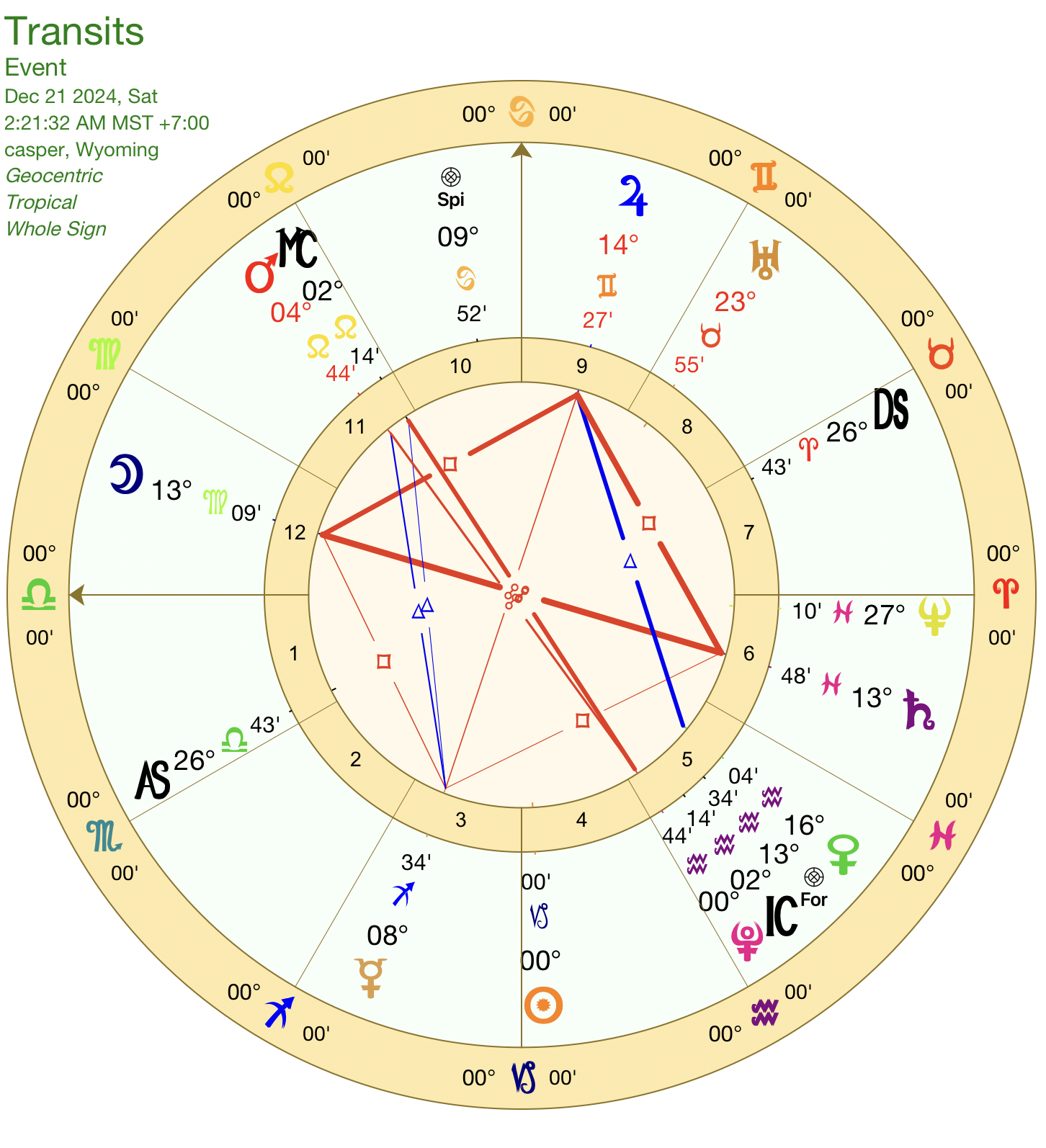
Solar Ingress: Dec 21, 2025 - Prediction
This ingress presents a winter shaped by angular tension, imbalance, and misdirected momentum. The forecast leans cold, unstable, and moisture-challenged, with one of the standout features being how much energy is misaligned. Systems that build but don’t break, or storm setups that don’t quite land.
The angular placements suggest directional pressure: Pluto on the IC brings deep northern cold, while Mars Rx on the MC points to reversed or blocked southern storm development. A mutable T-square further adds to the disorganization. Lots of motion, not much cohesion.
Key Planetary Indicators
Pluto Conjunct IC (Aquarius)
Suggests deeply rooted cold air descending from the north. This placement tends to lock in Arctic highs or extend the duration of cold snaps. Potential for persistent inversions and frigid stagnation.
Mars Retrograde Conjunct MC (Leo)
Storm energy is present but likely misdirected or stalled. Mars retrograde at the Midheaven often signals south-driven systems that fail to fully materialize, or events that build pressure but result in less impact than expected. Can also create dry, gusty days with little moisture delivery.
Moon in Virgo Opposite Saturn in Pisces (Square Jupiter Rx in Gemini)
This mutable T-square is a classic sign of instability and dispersal. Systems form easily but often break apart or lose structure before full expression. Expect frontal confusion, temperature swings, and pressure fluctuations. Moisture availability exists, but timing is off.
Venus in Aquarius Trine Jupiter Rx in Gemini
This softer trine suggests brief, pleasant spells. Days with clear skies or mild highs. But it’s not a dominant force in the season. Think “windows between chaos.”
Sun in Capricorn / Mercury in Sagittarius
Marks a traditionally cold season core. Mercury in Sag favors dry, breezy air, and without major aspects, it remains a background influence unless activated later.
Seasonal Summary for Casper
This chart sets up a winter that is cold and scattered, not due to massive storms, but from misaligned pressure systems and broken moisture delivery. Expect unpredictability, with frequent weak storm attempts, brief temperature contrasts, and the possibility of wind-driven cold without significant snow.
Summary Points:
Temperature: Below average. Pluto on the IC favors locked-in cold; little fire-sign influence to break it.
Precipitation: Below normal. Moisture signatures are present but unstable; T-square scatters system coherence.
Storm Potential: Moderate. Potential energy exists but lacks follow-through. Some storms may fizzle or shift track.
Wind: Likely erratic. Mutable air sign (Gemini) at the T-square apex, plus Mercury in Sag, increases directional gusts.
Fog/Ice Fog: Possible, especially with inversions tied to Pluto on the IC, but not a primary marker this season.
Conclusion
This is a cold, fractured winter pattern. The season may be frustratingly inactive at times, signals of incoming weather that never arrive, or fast-moving systems that deliver little more than a shift in wind. Mars retrograde and the mutable T-square highlight how energy may misfire, with a few well-timed events standing out against a backdrop of dry instability. Cold leads. Moisture follows…sporadically.
Results
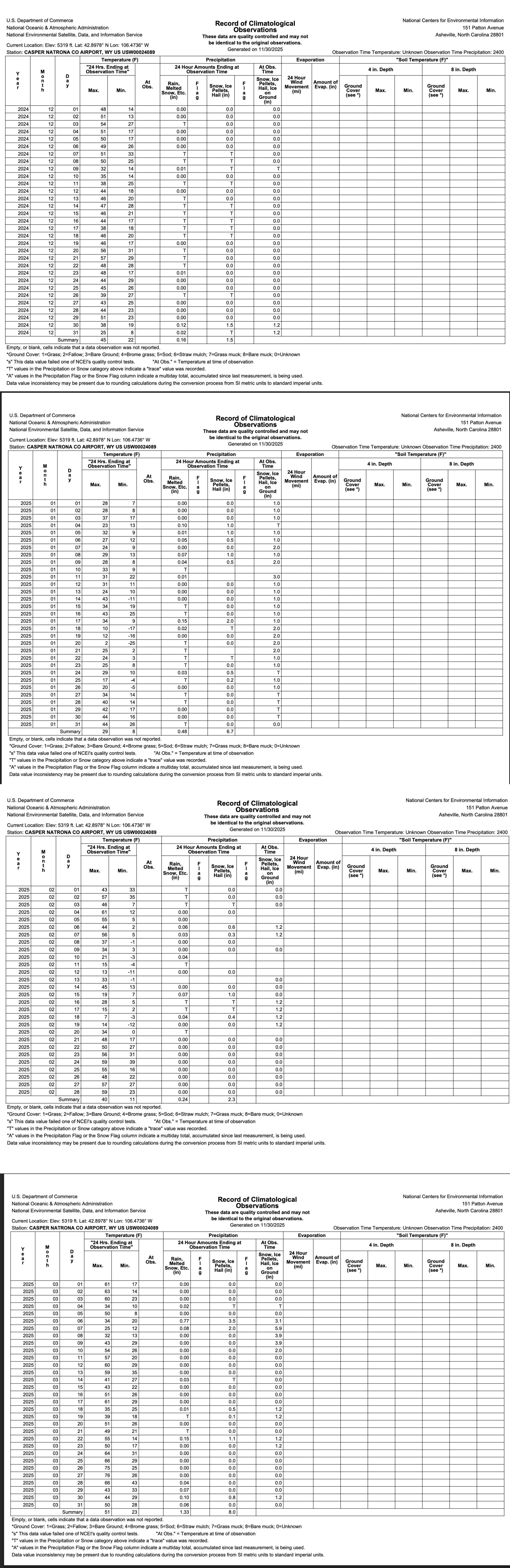
I also used the data from Time & Date.
Winter 2024–25 Observational Analysis Casper, WY
Forecast Window: Dec 21, 2024 – Mar 21, 2025
The ingress forecast accurately captured the core characteristics of this season: persistent cold, low precipitation, and structural instability in storm development. Where it diverged was in storm strength and wind output, there was less volatility than Mars and the T-square suggested. While the Mars Rx on the MC and Pluto on the IC effectively predicted blocked frontal systems and cold air dominance, storm expression was more subdued, even in March. The Jupiter Rx trine appears to have softened or delayed moisture activation, with most systems underperforming until a late-season uptick.
What Matched
Cold, Arctic-Dominant Pattern:
Pluto conjunct the IC clearly played out. January 14–21 saw deep freeze events with temperatures dropping to –25°F, confirming the dynamic expected from a lower-axis Pluto contact.Below-Normal Precipitation:
Precipitation was consistently low, particularly in late December, January, and mid-February, with many “T” (trace) values logged. This aligns with a lack of angular water-sign planets and an overall scattered storm structure from the mutable T-square.System Breakdown & Instability:
The Moon/Saturn opposition squaring Jupiter Rx in Gemini reflected in multiple false-start systems. Fronts with cloud build-up or trace precip that failed to consolidate. This pattern held repeatedly in January and February.March Storm Spike (But Not Overwhelming):
A measurable snow event (March 5–˘7) brought 5.9 inches over two days, validating the forecast call for “one or two stronger systems.” However, this was less aggressive than the Mars Rx signature might imply.
What Diverged & Why
Underwhelming Storm Energy:
The Mars retrograde at the MC didn’t fully deliver on high wind or dramatic frontal passage. Wind values remained moderate, and few events featured strong gradients. One reason may be that Mars Rx lacks expression power, its retrograde motion symbolizes pressure without release, a potential misfire of expected intensity.Jupiter Rx Timing Effects:
While forecasted to enable “slow-moving systems,” Jupiter’s retrograde position and weak angularity likely delayed meaningful moisture transport until March. Even then, the activation was modest. This may suggest that a Jupiter Rx needs stronger angular or lunar activation to contribute meaningfully to winter storm generation.Mutable T-Square: Less Wind, More Drift:
The Virgo/Pisces/Gemini configuration favored scatter over speed. While the forecast highlighted directional instability, it overestimated wind and underestimated system evaporation. Many incoming patterns in Jan–Feb simply broke down. fog, flurries, or nothing, which might indicate that a mutable T-square needs angular planets or a Cardinal outlet to create impactful movement.
Season Summary – Dec 21, 2024 to Mar 20, 2025
Temperature:
Below normal. Dominated by January’s deep Arctic plunge. Pluto on the IC tracked perfectly with stagnant cold pools and persistent high pressure over Wyoming.
Precipitation:
Well below normal. Total seasonal precipitation barely topped 1.5 inches, with snowfall at ~13.9 inches. Most of it came from a single system in March.
Storm Strength & Frequency:
Under-delivered. Despite energetic signatures (Mars Rx, T-square), storm expression was muted. March brought some lift but never full release.
Wind:
Moderate, not exceptional. Few days reached 3+ miles/day wind movement. Angular Mars in Leo (Rx) may have created pressure buildup without follow-through.
Moisture Behavior:
Fragmented. Consistent with Venus trine Jupiter Rx and mutable T-square. Moisture was present, but mistimed or scattered, leading to dry cloud systems and flurries without depth.
Working Theories & Interpretive Notes
Mars Rx + MC = Atmospheric Gridlock
Rather than initiating storms, Mars Rx seems to act like a valve stuck halfway open. Systems signal, but don’t express. Its MC placement may block southern flows or misalign vertical motion.Pluto on IC = Locked Arctic Highs
This configuration is proving reliable for deep cold anchoring and long-duration inversions, especially when unaided by warm-signal overrides.T-Squares Need Angles to Trigger
Mutable T-squares create instability, but without angular planets or strong lunar triggers, they may result in drift, scatter, or low-impact fragmentation.
Overall Assessment
The ingress forecast held strong: cold, dry, uneven, with minor volatility. While some dynamics (like wind and storm expression) underperformed, the cold and dryness were fully realized. This chart shows how retrogrades and mutables can delay or defuse energy, even when the ingredients appear turbulent.