Astro-meteorology is the study of how planetary alignments correlate with weather patterns. This page documents an ongoing research project focused on analyzing seasonal ingress and lunar phase charts to understand and anticipate atmospheric trends.
Here, I track, test, and archive forecasts using principles drawn from Predicting Weather Events with Astrology by Kris Brandt Riske (Llewellyn Publications), and Weather Studies: Introduction to Atmospheric Science (7th Edition) by Elizabeth W. Mills et al., published by the American Meteorological Society.
It’s further supported by historical data, local observations, and planetary ephemerides. The goal is to evaluate astrological weather techniques through structured, testable methods, focusing on precipitation, temperature, wind, and storm behavior across locations and timeframes.
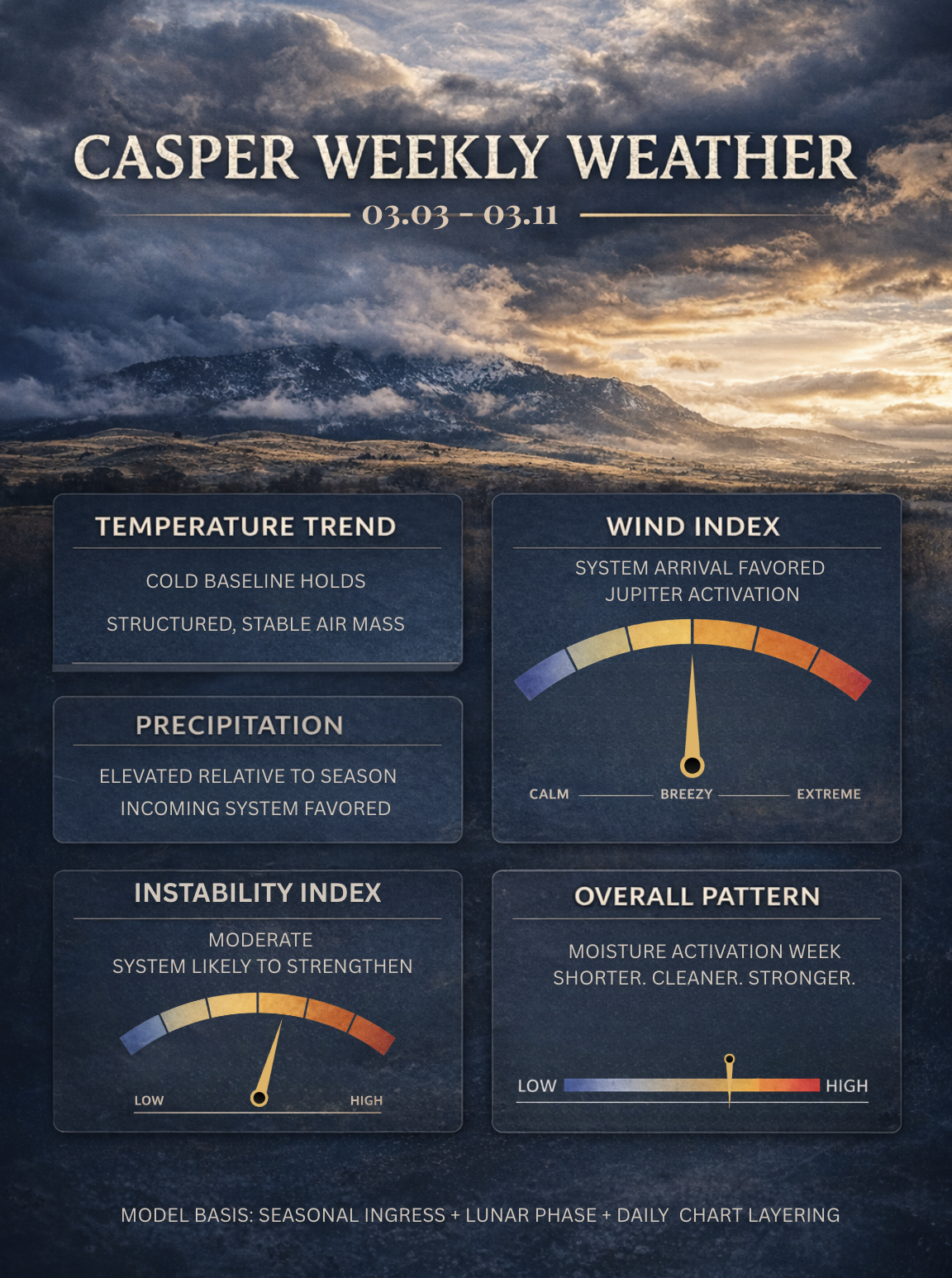
Casper 03.03 - 3.11
This week’s lunar phase brought some notable structural shifts in the sky — particularly a Full Moon lunar eclipse layered over the winter’s seasonal framework.
The seasonal chart has already set a cold, structured tone for this winter (Mars rising in Capricorn), and this week activated one of the key moisture signatures in that pattern.
Here’s what was in play:
• The lunar Descendant aligned with seasonal Jupiter increasing the potential for incoming systems
• A Saturn–Neptune conjunction supported organized moisture
• Mars provided forward motion
• Mercury retrograde added some timing and track uncertainty
The result: elevated precipitation potential compared to earlier weeks, with conditions favoring a broader system rather than isolated flurries though exact timing and totals depended heavily on how the moisture aligned.
This continues to be part of an ongoing research project testing how lunar phases interact with seasonal ingress charts in real time.
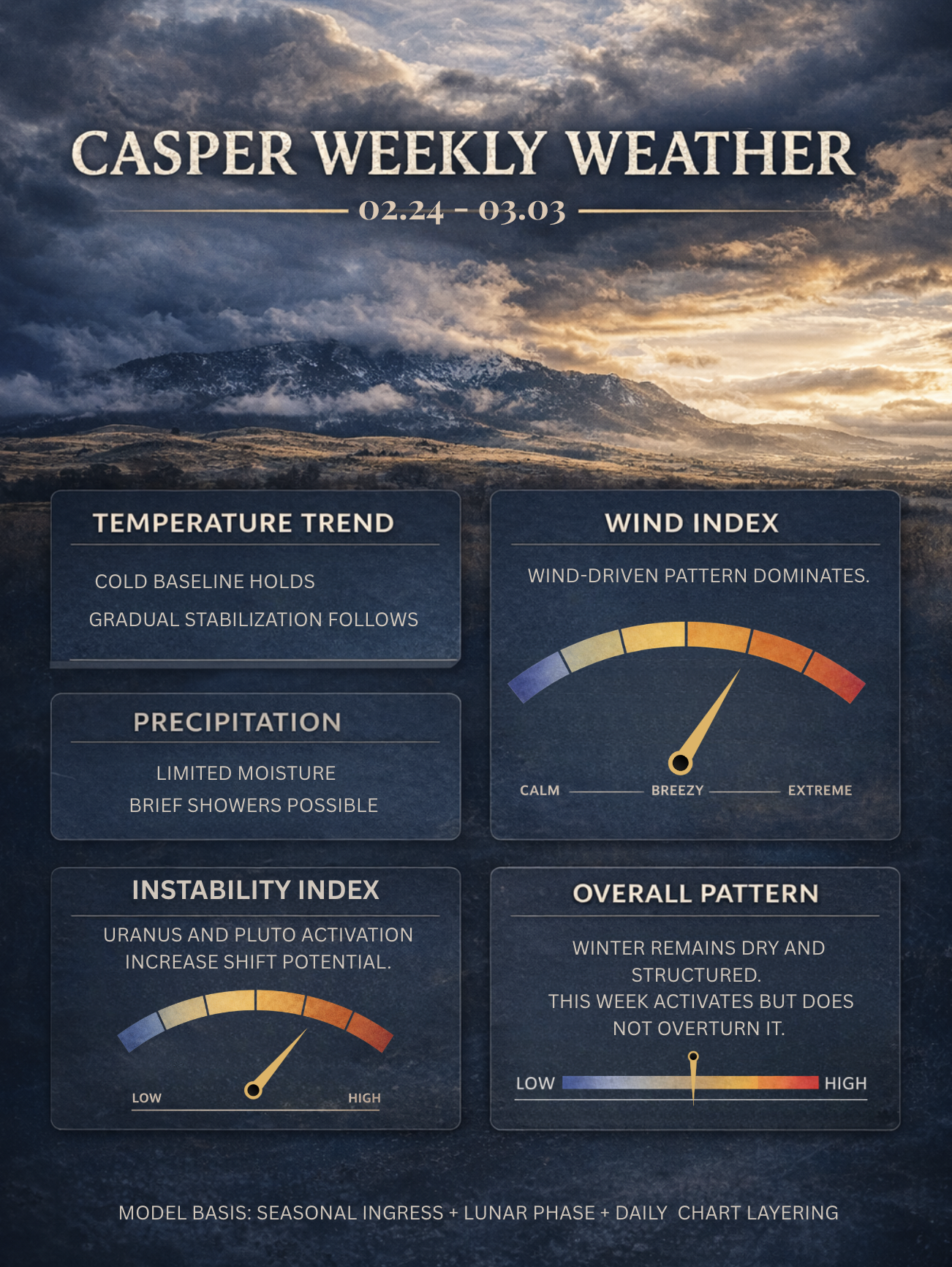
Casper 02.24 - 03.03
Casper Weekly Weather Update - Lunar Activation Week
This week is being driven by the current lunar phase activating key points from the winter chart.
In simple terms: the bigger seasonal pattern gets “turned on” briefly.
The Moon is triggering Pluto and Uranus from the winter setup. When those two are activated together, it often shows up as noticeable change, tightening pressure, a sharper temperature drop and quick moving fronts rather than slow transitions.
Mars forming tension with Uranus in the weekly chart adds to that signal. That combination leans wind-driven and favors rapid adjustments over gradual ones.
There is some moisture available in the atmosphere, but it would likely show up as fast moving snow bands or brief bursts rather than a prolonged storm cycle.
The broader winter pattern still favors dry and structured conditions. This week doesn’t overturn that but it does energize it.